Clinic offers fresh path to neurological rehabilitation
2025-10-16 15:18:31 來源:人民網 
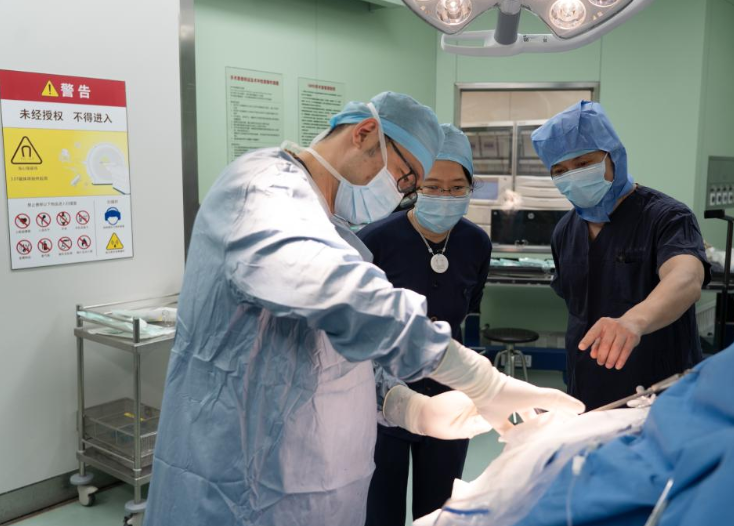
Doctors conduct the clinical trial of the invasive brain-computer interface in East China's Shanghai, March 25, 2025. [Photo/Xinhua]
Outside a consultation room at Zhejiang Provincial People's Hospital in Hangzhou, the provincial capital, Liu tightly clutches her husband's medical records, unable to conceal her excitement and anticipation.
Her husband lost sensation and motor function below the waist after a traffic accident damaged his spinal cord. Liu (not her real name), after learning that the hospital had opened a brain-computer interface and neuromodulation evaluation outpatient clinic on Wednesday, came to the city hoping that the treatment would help ease her husband's suffering.
Brain-computer interface, or BCI, technology enables interaction between biological and machine intelligence by building information channels between the human brain and machines.
As the first clinic of its kind in the province, all appointment slots were instantly snapped up.
"After a spinal cord injury, the disruption of neural pathways is the core challenge. Our brain-computer interface technology can capture the brain's signals of 'intent to move', assisting movement through exoskeletons or functional electrical stimulation.
"Simultaneously, it incorporates neuromodulation to improve muscle tone and reduce the risk of complications," Ye Xiangming, chief physician in charge of the clinic, told Liu. Neuromodulation is the alteration of nerve activity through electrical stimulation or chemical agents.
As traditional methods fail in the treatment of some neurological diseases, the use of BCI technology is expected to find new paths to recovery, Ye said.
Among the first group of patients seeking help at the clinic were those suffering from strokes, spinal cord injuries, Parkinson's disease, Alzheimer's disease, amyotrophic lateral sclerosis, refractory epilepsy and major depressive disorders, and many of the patients were from outside the province, according to the hospital.
Patients need to undergo a multidimensional assessment before three experts collaboratively evaluate their rehabilitation potential, feasibility of surgical intervention, and psychological adaptability, in order to determine whether they are suitable for the therapy.
"BCI technology can help patients recover faster and better. For example, many patients who have had a stroke cannot complete precise hand movements. But BCI can shorten treatment time from about three months to one-and-a-half months, also helping them improve their ability in daily life," he said.
Ye added that noninvasive treatment has been proved safe, with infection being the main risk in semi-invasive and invasive treatments.
Furthermore, "since the device is not opened to the wide internet, and the whole process is strictly controlled, there is no access for hackers", he said, adding that there is great potential for expanding applications and improving the therapeutic effects of brain-computer interface technology.
Currently, the clinic serves four categories of patients: those with severe motor dysfunction, hearing loss, refractory neurological and psychiatric disorders, and communication impairments.
Since May, when Beijing Tiantan Hospital opened the country's first BCI clinic, such services have been expanded to more places, including Wuhan in Hubei province and Shenzhen in Guangdong province.
In August, multiple Chinese authorities jointly issued a set of guidelines aimed at promoting the innovative development of the BCI industry, including calls for the accelerated adoption of brain-computer interface products across sectors such as industrial manufacturing, healthcare and consumption by 2027.
The National Medical Products Administration released China's first standards for BCI medical devices in September.
Qu Yan, director of neurosurgery at Tangdu Hospital of Air Force Medical University in Xi'an, Shaanxi province, said: "The establishment of BCI outpatient clinics provides a standardized and professional channel for consultation and assessment to patients with real needs. This not only helps screen for patients who are most suitable for clinical trials or treatment, but also gives direct feedback to the scientific research side."
Qu added that managing the expectations of patients and the public is the greatest challenge. "BCI's clinical application is still in a very early exploratory stage," he said. "Technologically, both invasive and noninvasive methods face bottlenecks such as signal stability, long-term biocompatibility and the accuracy of decoding algorithms," he added.
In addition, he said surgical risks, data privacy and complex ethical issues are hurdles that must be overcome before large-scale promotion can occur.
Wei Wangyu contributed to this story.
編輯: 馬路遙
 以上文章僅代表作者個人觀點,本網只是轉載,如涉及作品內容、版權、稿酬問題,請及時聯系我們。電話:029-63903870
 神木:深耕質量沃土 篤行奮進
 鳳翔區農業發展與特色產業的
 “大地回響——秦腔與昆曲影
 運動慶豐收
運動慶豐收 橫山區:稻蟹共生 繪就鄉村振
 漢中市寧強縣特色墻繪成新晉
 “走讀絲路·行閱中亞”2025跨國圖書出版交
 寶雞隴縣49件國寶級文物驚艷亮相澳大利亞
  西鳳酒亮相2025韓國葡萄酒與烈酒博覽會
 High-tech exhibits displayed at 9th Chin