China embraces two-wheel mobility as a green urban transportation solution
2025-09-26 11:12:33 來源:人民網 
2025-09-26 11:12:33 來源:人民網

People cycle on a country road in Guanlu village, Qianxian county, Huangshan, east China's Anhui province. (Photo/Xu Jiadong)
China's urban transport landscape is increasingly characterized by "two-wheel mobility" - primarily bicycles and electric scooters - which has become a vital component of sustainable urban development.
According to the China Bicycle Association, China's bicycle ownership has topped 200 million, with an additional 380 million electric-powered two-wheelers in use. Chinese urbanites use bicycles or e-bikes for about 30 out of every 100 trips they make. The figures point to a shift in China, where growing environmental awareness is prompting more commuters to opt for two-wheeled, low-carbon alternatives.
"Bicycles and e-bikes are well-suited for short- and medium-distance urban travel. As health and sustainability become greater public priorities, two-wheel mobility continues to gain momentum," said Guo Wenyu, vice president and secretary general of the association.
A 2024 report on green mobility indicates that from 2021 to 2023, the average urban bicycle trip lengthened from 12.6 minutes to 13.88 minutes, particularly during peak hours when these modes of transport offer notable time savings. Compared with traditional vehicles, two-wheel mobility also provides clear advantages in terms of cost efficiency and environmental impact.
Daily use of two-wheel transport reduces national carbon emissions by approximately 10,000 tons, equivalent to saving 6.6 million liters of gasoline, based on an average fuel consumption rate of 8 liters per 100 kilometers. In 2023 alone, this reduction totaled 4.29 million tons, translating to environmental cost savings of roughly 2.6 billion yuan.
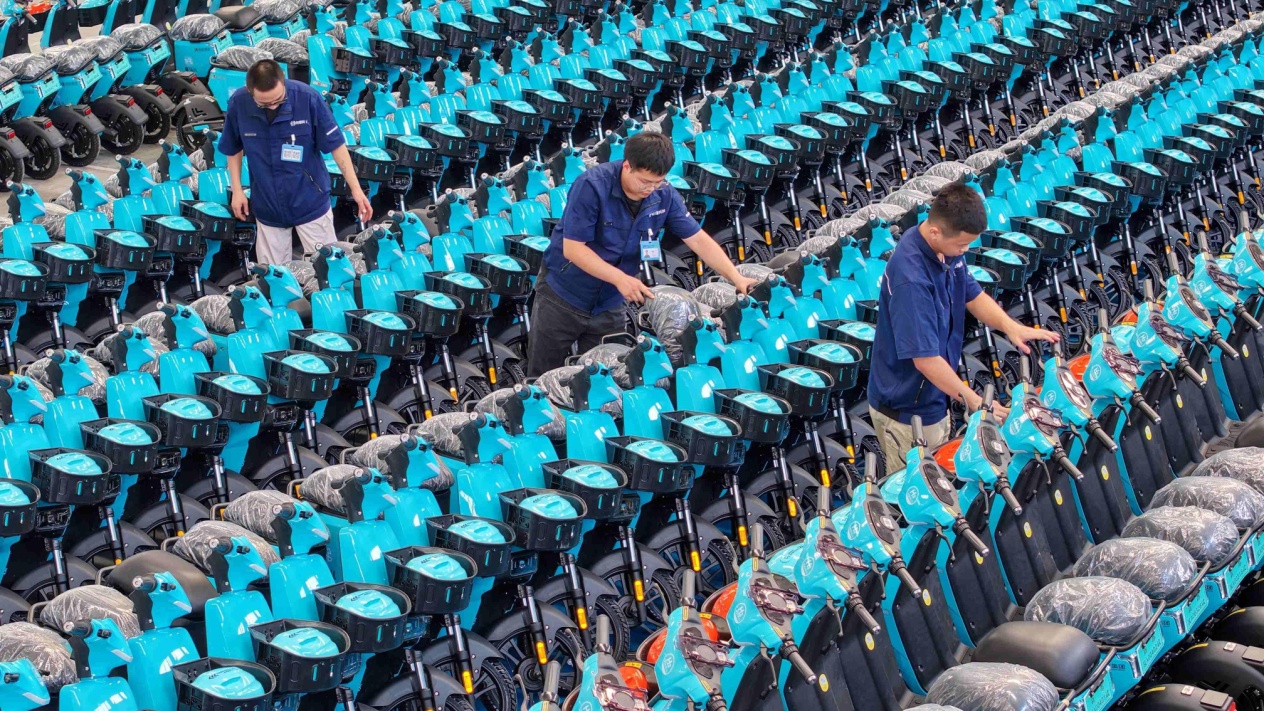
Hydrogen-powered shared bikes are about to be launched in Xindu district, Chengdu, southwest China's Sichuan province. (Photo/Li Xiangyu)
The growing popularity of cycling culture has further propelled this trend. "Ride-and-tour" tourism is becoming popular, with over 18 million cycling enthusiasts and more than 100 million regular cyclists across China.
Shared bicycles have become a cornerstone of urban public transportation, with more than 12 million in operation and approximately 24 million rides taken daily. Technological advancements, such as BeiDou-enabled bike tracking, have improved the efficiency of bike-sharing services. Meituan, a major provider, reported over 10 billion kilometers traveled through its shared two-wheel platform last year, avoiding more than 580,000 tons in carbon emissions. According to a Meituan executive, roughly 23 percent of these trips replaced travel that would have otherwise been made by car.
As urban transportation systems continue to modernize, the integration of cycling with rail transit is becoming increasingly prevalent across Chinese cities. To facilitate this multimodal connectivity, local governments are enhancing infrastructure by constructing sheltered walkways, expanding bike parking facilities, and designating parking zones near transit stations. These efforts aim to create seamless transitions between two-wheel mobility and public transit, reinforcing the shift toward greener urban transportation.
From 2021 to 2023, the proportion of bicycle trips near rail transit stations rose steadily nationwide. Notably, e-bike usage around these hubs increased by 13 percent in 2022 and an additional 11.3 percent in 2023, underscoring their expanding role in last-mile connectivity. Guo observed that e-bikes are increasingly favored over traditional bicycles, as their functionality better aligns with the demands of short-distance urban travel.
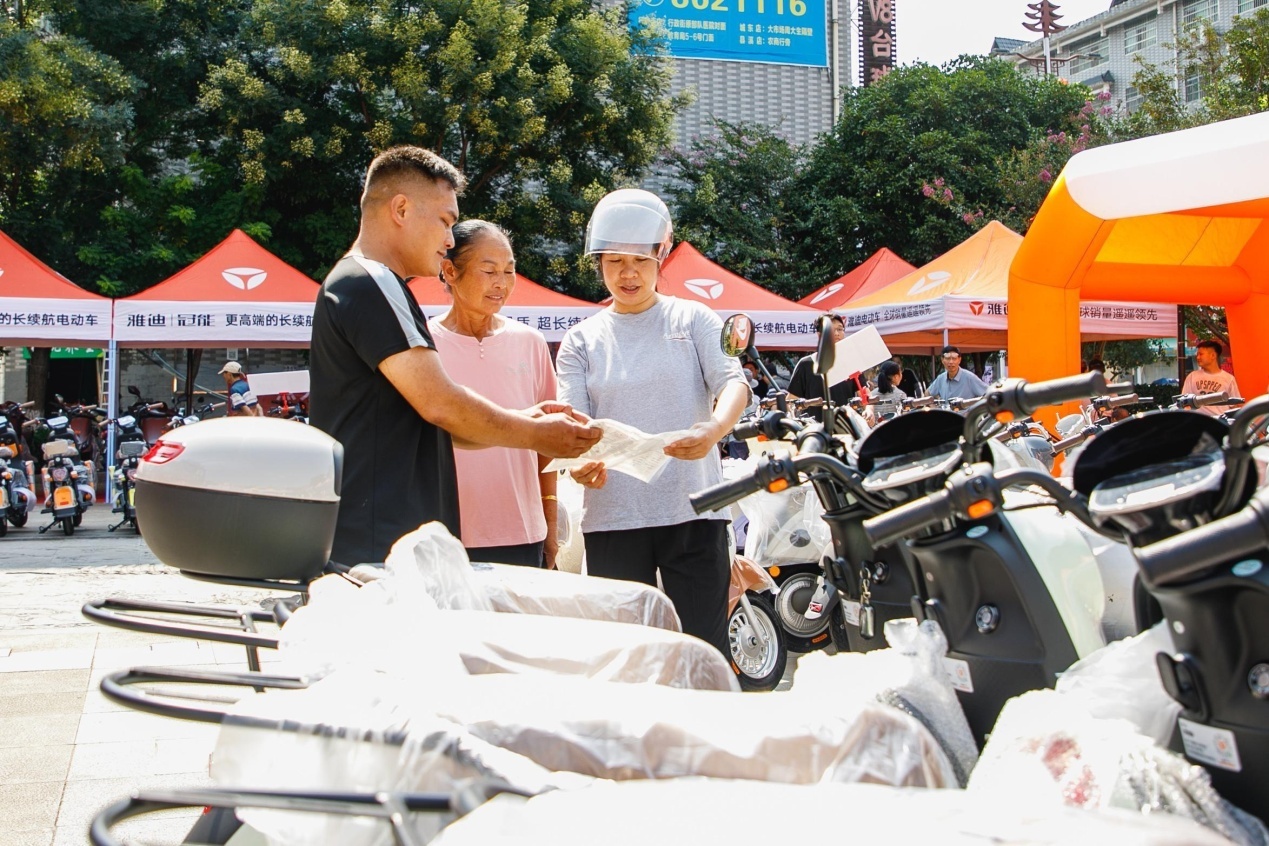
A woman buys an electric scooter in Shuangjiang township, Tongdao Dong autonomous county, Huaihua, central China's Hunan province. (Photo/Hu Xianbing)
In a recent innovation, Qingdao's West Coast New Area launched 200 hydrogen-powered shared bicycles in June. These bikes, which can be unlocked via mobile scan, offer faster refueling and an extended range of up to 100 kilometers, outperforming traditional e-bikes in both convenience and efficiency.
As China's bicycle inventory expands, end-of-life management has become an increasingly pressing concern. Many regions are adopting circular economy practices for the retirement and recycling of bikes. In the Guangdong-Hong Kong-Macao Greater Bay Area, the bicycle recycling rate has reached approximately 25 percent, while the shared bicycle sector has achieved near-total recycling and reuse of decommissioned units.
"Two-wheel mobility has evolved from a basic mode of transportation into a healthier, more sustainable lifestyle," Guo noted. "More people are using cycling not only to commute, but also to explore their cities, mapping their lives through the routes they take." With continued infrastructure development and rising environmental awareness, two-wheel mobility is set to remain a key driver of green urban development.
編輯: 馬路遙
 以上文章僅代表作者個人觀點,本網只是轉載,如涉及作品內容、版權、稿酬問題,請及時聯系我們。電話:029-63903870
 運動慶豐收
運動慶豐收 橫山區:稻蟹共生 繪就鄉村振
 漢中市寧強縣特色墻繪成新晉
 2025年陜西省體能大賽預選賽
 洛南竹編:老手藝綻放新光彩
 滿“新”歡喜啟新程
 “走讀絲路·行閱中亞”2025跨國圖書出版交
 寶雞隴縣49件國寶級文物驚艷亮相澳大利亞
  西鳳酒亮相2025韓國葡萄酒與烈酒博覽會
 High-tech exhibits displayed at 9th Chin